I got a note from a friend of mine in Australia recently. Regarding flying, he said.. "Would like to try it some time, though reading some of the other more recent posts makes me wonder how safe it really is!"
He was referring to posts I have written on this blog that mention accidents and incidents and, understandably it has raised a good deal of concern with him (and, no doubt, with other readers of his blog)

Let me tell you, there is nothing to be scared of when it comes to flying. Statistically it is still the safest way to travel. Statistically you are more likely to be hit by a meteor than be killed while flying (I'm not sure if that's true, but it illustrates a point!)
However: It is a well known fact that there are plane crashes every year. In fact there are quite a few plane crashes every year. A lot of them don't get talked about too much (small planes crashing in wilderness etc.). Some of them make the news, but not all (Colin McRae's helicopter crash last year and the Cessna Citation jet that crashed in Kent killing racing driver John Leslie). Mostly these get publicity more for the people who were on board than for the accident itself.
But there are, occasionally, large accidents that get coverage due to the sheer scale. The largest accident on record was the crash between two 747's on the tarmac at Tenerife in the 1970's. The Lockerbie bombing in the 80's and the 4 jets that went down on September 11th 2001 were terrorist attacks rather than accidents. TWA 800, the 747 that blew up over Long Island was an electrical short circuit.. the list goes on and on.
So let's put this in perspective. According to the National Safety Council, who have been logging US safety-related accidents since 1920, the odds of dying in an air or space related accident in the US in 2004 were 1 in 432,484. Compare this with the odds of dying in a car (1 in 19,216), pick-up truck (1 in 75,142) or as a pedestrian (1 in 49,139). What about "Inhalation and ingestion of other objects causing obstruction of respiratory tract" (1 in 91,340) or "Accidental poisoning by and exposure to noxious substances" (1 in 14,017) or "Assault by firearm" (1 in 25,263).
If you want actual data, 697 people were killed in aviation or space related accidents in 2004. That compares with 5976 pedestrians, 4018 motorcyclists, 15282 car occupants, 15494, 'Other and unspecified land transport accidents' and 17357 who were shot, stabbed or otherwise killed in an assault. And that's just the USA alone! According to the CAA in the UK, over the 1985-94 period, only 0.2 passengers were killed or seriously injured per billion passenger km flown by UK operators. This compares with 1872 on motorcycles, for example.
The fact of the matter is when you are in a large commercial plane the number of things that have to occur to cause a fatal accident are huge. It is very rarely a single issue that brings a plane down. It is usually a chain of events, missed items, mechanical issues and pilot error that all come to a point and cause the incident. Anyone who's watched National Geographic's "Air Crash Investigation' will know this. The Tenerife incident I mentioned earlier was caused by a combination of bad weather, no radar, tight crew schedules, an overbearing Captain who intimidated his crew, and a misheard radio communication. If any one of those had not been present the accident would have been avoided. Similarly, the TWA flight 800 crash was caused by the plane carrying an empty centre fuel tank coupled with decreased pressure from flying at altitude and a short circuit in a single wire (The empty fuel tank contained kerosene vapour which ignited when the spark from the short circuit met the lightly pressurised vapour). Once again a change in any of these circumstances would have prevented it (Standard operating procedure is now to keep fuel in the central tank to avoid the situation where vapour can form).
But when it comes to the smaller, general aviation planes of the type that I fly, the prospect of an incident is larger. The systems are simpler, but the pilots are less experienced (or more particularly they are less trained in all circumstances). This leads to situation where a single problem can cause an incident. In this years 'Clued Up' magazine from the CAA, Irv Lee talks about a carb icing problem he had which caused his engine to die and necessitate an emergency landing in a field. The cause of this was very simple: His student throttled back to start a decent without adding carb heat. As Irv himself says "That was the end of the flight". This wasn't a case of 3 or four things conspiring to cause an issue it was one simple mistake - a pilot error - as the student didn't follow his procedures correctly.
But again, to put all this into context, there were 14 fatal aeroplane accidents last year in the UK. The CAA believe that there were around 900,000 hours of general aviation flying in that time. That's not a bad ratio.
Of course a lot of the hoopla surrounding aviation accidents is causing many people to have a fear of flying. Most of this is to do with lack of control. But some of it is to do with not understanding how planes fly (I was on a long distance BA flight a number of years ago. As we rattled down the runway and the plane clawed it's way into the sky I shook my head in disbelief that 300 tonnes of metal, people and fuel could get airborne. The elderly lady seated next to me said 'Why are you shaking your head?"
"I fly upwards of 100 to 200 flights per year", I replied, "And I still don't really understand how it works. But it's not a problem as long as the pilot does" She smiled and leaned over to me 'It's OK", she said "The pilot know what he's doing. It's my husband").
One of the ways of combating this is to go on a fear of flying course. My mother took one of these recently. She used to hate flying, needed valium type pills to calm her down and remove the anxiety she was feeling. But she spent a day at Manchester Airport with British Airways and went on a 30 minute flight where the captain talked everyone through what was happening, and she nows flies 6 or 8 times a year to various destinations without any medication. It doesn't mean she likes flying, but it has removed her fear and anxiety.
So should my Australian friend be scared of flying in small aircraft? Absolutely not. They are statistically a lot safer than any other form of transport. Most occurrences are caused by pilots flying outside their comfort zone (into bad weather for example), and of the incidents that are reported, very few are fatal.
I'd rather be flying than in a car, personally!
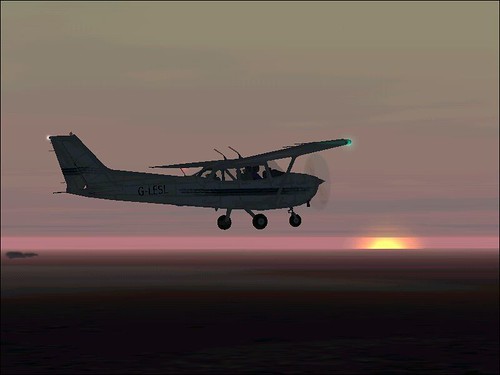
(Graphic courtesy www.lumaxart.com/)
Technorati Tags: caa, GA, safety, aviation
He was referring to posts I have written on this blog that mention accidents and incidents and, understandably it has raised a good deal of concern with him (and, no doubt, with other readers of his blog)
Let me tell you, there is nothing to be scared of when it comes to flying. Statistically it is still the safest way to travel. Statistically you are more likely to be hit by a meteor than be killed while flying (I'm not sure if that's true, but it illustrates a point!)
However: It is a well known fact that there are plane crashes every year. In fact there are quite a few plane crashes every year. A lot of them don't get talked about too much (small planes crashing in wilderness etc.). Some of them make the news, but not all (Colin McRae's helicopter crash last year and the Cessna Citation jet that crashed in Kent killing racing driver John Leslie). Mostly these get publicity more for the people who were on board than for the accident itself.
But there are, occasionally, large accidents that get coverage due to the sheer scale. The largest accident on record was the crash between two 747's on the tarmac at Tenerife in the 1970's. The Lockerbie bombing in the 80's and the 4 jets that went down on September 11th 2001 were terrorist attacks rather than accidents. TWA 800, the 747 that blew up over Long Island was an electrical short circuit.. the list goes on and on.
So let's put this in perspective. According to the National Safety Council, who have been logging US safety-related accidents since 1920, the odds of dying in an air or space related accident in the US in 2004 were 1 in 432,484. Compare this with the odds of dying in a car (1 in 19,216), pick-up truck (1 in 75,142) or as a pedestrian (1 in 49,139). What about "Inhalation and ingestion of other objects causing obstruction of respiratory tract" (1 in 91,340) or "Accidental poisoning by and exposure to noxious substances" (1 in 14,017) or "Assault by firearm" (1 in 25,263).
If you want actual data, 697 people were killed in aviation or space related accidents in 2004. That compares with 5976 pedestrians, 4018 motorcyclists, 15282 car occupants, 15494, 'Other and unspecified land transport accidents' and 17357 who were shot, stabbed or otherwise killed in an assault. And that's just the USA alone! According to the CAA in the UK, over the 1985-94 period, only 0.2 passengers were killed or seriously injured per billion passenger km flown by UK operators. This compares with 1872 on motorcycles, for example.
The fact of the matter is when you are in a large commercial plane the number of things that have to occur to cause a fatal accident are huge. It is very rarely a single issue that brings a plane down. It is usually a chain of events, missed items, mechanical issues and pilot error that all come to a point and cause the incident. Anyone who's watched National Geographic's "Air Crash Investigation' will know this. The Tenerife incident I mentioned earlier was caused by a combination of bad weather, no radar, tight crew schedules, an overbearing Captain who intimidated his crew, and a misheard radio communication. If any one of those had not been present the accident would have been avoided. Similarly, the TWA flight 800 crash was caused by the plane carrying an empty centre fuel tank coupled with decreased pressure from flying at altitude and a short circuit in a single wire (The empty fuel tank contained kerosene vapour which ignited when the spark from the short circuit met the lightly pressurised vapour). Once again a change in any of these circumstances would have prevented it (Standard operating procedure is now to keep fuel in the central tank to avoid the situation where vapour can form).
But when it comes to the smaller, general aviation planes of the type that I fly, the prospect of an incident is larger. The systems are simpler, but the pilots are less experienced (or more particularly they are less trained in all circumstances). This leads to situation where a single problem can cause an incident. In this years 'Clued Up' magazine from the CAA, Irv Lee talks about a carb icing problem he had which caused his engine to die and necessitate an emergency landing in a field. The cause of this was very simple: His student throttled back to start a decent without adding carb heat. As Irv himself says "That was the end of the flight". This wasn't a case of 3 or four things conspiring to cause an issue it was one simple mistake - a pilot error - as the student didn't follow his procedures correctly.
But again, to put all this into context, there were 14 fatal aeroplane accidents last year in the UK. The CAA believe that there were around 900,000 hours of general aviation flying in that time. That's not a bad ratio.
Of course a lot of the hoopla surrounding aviation accidents is causing many people to have a fear of flying. Most of this is to do with lack of control. But some of it is to do with not understanding how planes fly (I was on a long distance BA flight a number of years ago. As we rattled down the runway and the plane clawed it's way into the sky I shook my head in disbelief that 300 tonnes of metal, people and fuel could get airborne. The elderly lady seated next to me said 'Why are you shaking your head?"
"I fly upwards of 100 to 200 flights per year", I replied, "And I still don't really understand how it works. But it's not a problem as long as the pilot does" She smiled and leaned over to me 'It's OK", she said "The pilot know what he's doing. It's my husband").
One of the ways of combating this is to go on a fear of flying course. My mother took one of these recently. She used to hate flying, needed valium type pills to calm her down and remove the anxiety she was feeling. But she spent a day at Manchester Airport with British Airways and went on a 30 minute flight where the captain talked everyone through what was happening, and she nows flies 6 or 8 times a year to various destinations without any medication. It doesn't mean she likes flying, but it has removed her fear and anxiety.
So should my Australian friend be scared of flying in small aircraft? Absolutely not. They are statistically a lot safer than any other form of transport. Most occurrences are caused by pilots flying outside their comfort zone (into bad weather for example), and of the incidents that are reported, very few are fatal.
I'd rather be flying than in a car, personally!
(Graphic courtesy www.lumaxart.com/)
Technorati Tags: caa, GA, safety, aviation