Showing posts with label links. Show all posts

15 May, 2009

How do Ryanair make money?

Boeing 737-800 at Manchester International Air...Image via Wikipedia

I read an interesting article from Wired magazine recently which basically stated that on a typical London to Barcelona flight it costs Ryanair $70 per seat. (This is the cost to the airline NOT the price of the ticket).

So I got to thinking about this and wondered about the economics.

The plane used on that flight will probably be the B737-800 which has 180 seats. At $70 per seat the cost of the flight is $12600. The flight lasts somewhere in the region of 2 hours therefore the cost per hour to Ryanair is $6300.

Within that $6300 the following has to be included:

  • Fuel for 1 hours flight on a medium sized 2 engine commercial airliner
  • Half the landing fee for the destination airport
  • 1 hours salary for a pilot and co-pilot
  • 1 hours salary for 4 cabin staff
  • Maintenance costs for 1 hours flight
  • Aircraft leasing costs for 1 hours flight
  • 50% of the handling fees for the baggage at the destination.
  • Salary of the check-in staff at the departure airport
  • A proportion of head-office overhead fees
  • Profit.

Let's take the head office overhead and the profit out of there so as not to confuse matters too much.

Now let's look at some figures we know: A Gulfstream IV aircraft carries up to 13 passengers over 4500 miles at a time. It has two small engines and can be leased for around $5200 per hour

Commercial aircraft leasors will lease an Airbus A320 (similar to a Boeing 737) on an
ACMI (Aircraft, Crew, Maintenance & Insurance model) (i.e without fuel and other costs) for $2750 per hour On top of that the airline will have to pay for items such as:

  • fuel and oil;
  • aircraft landing, handling, navigation and terminal charges;
  • passenger and cargo handling;
  • airport taxes, all passenger related taxes and security taxes;
  • aircraft parking and ground security;
  • ramp services including towing, push-back, de-icing, nitrogen and oxygen services;
  • all dry goods, including but not limited to head rest covers, airsickness bags, blankets and pillows;
  • ATC fees and all international route charges;
  • cabin cleaning and water services;
  • aircraft interior deep cleaning and exterior cleaning;
  • airport security passes and permits, if required;
  • over-flight permits;
  • custom taxes, immigration and inspection fees, import and export duty's;
  • landing and traffic permit and slots;
  • office space including telephone, fax, email;
  • spare parts facilities (storage) including air conditioning;
  • one van for transportation of mechanics and parts;
  • insurance - passengers, baggage, mail, cargo and war risk insurance;
  • any additional cost reference to insurance coverage will be on Lessee's account;
  • any and all other reasonable direct operating costs, incurred in the performance of the flights whether or not listed above.
Aviation fuel is currently charged at around $830 per metric tonne (assuming a 45% reduction of the price of $1280 at the height of the fuel issues). Fuel to Barcelona is about 6.65 metric tonnes which gives a cost per hour (assuming the two hour flight) of $2400

So we know so far that we are looking at approx ($2400 + $2750 = $5150) just for the aircraft and fuel The landing charge at Barcelona is approx €6 per tonne which would equate to approx €250 for the plane or €125 per hour. This doesn't include any of the salaries for the crew, nor any of the additional costs listed above. Flight crew earn less than $72 per hour (which equates to $145 per hour for the two flight crew) Cabin crew are on considerably less than that (say $20 per hour * 4 = $80.

While these figures are only approximate (and the result of some investigative digging on the internet), it does prove a couple of things

1) Ryanair are not good staff payers
2) The margins are very thin
3) Somewhere cuts must be being made to ensure the costs are kept down. Remember in the remaining $100 per hour Ryanair must pay for ALL the maintenance costs, and insurance as well as those costs detailed in the list above

How do they do it? Are my figures inaccurate? Can anyone with inside information let me know please?


13 May, 2009

Cost free flying? Worth considering...

Huidige verkeerstoren op :nl:Schiphol en links...Image via Wikipedia

What if I told you there was a way to fly as often as you like, in all weathers, in whichever aircraft you want, from wherever you want, with live ATC and it won't cost you anything. You'd like that wouldn't you? Of course you would. But you would also want to know what the catch was wouldn't you?

Well, I have one word for you: Simulation.

Flight simulation is a growing industry. Since the early days of the Microsoft Flight Simulator the state of the art has moved on in leaps and bounds. Whole industries have sprung up to manage the ancilliary markets with thing such as new planes, scenery and adventures. A whole host of forums, web-sites and communities have appeared dedicated to the art and science of flight simulation. I even heard about a guy who is building his own 747 flight simulator - with full motion control - in his garage!

The problem with a lot of this was always twofold:


1) Even if you get all the latest add-on's, up-to-date software and patches, it was still a case of sitting in your room staring at a screen and playing with a keyboard.
2) It didn't fully replicate the flying experience because it was missing one vital ingredient - proper Air traffic control.

Well unfortunately the problem of 1) is not going to go away soon. Even the guy building his own 747 simulator is still a guy sat at home - albeit with some sophisticated machinery. But the problem of 2) is more easily solved.

Flight sim manufacturers have included some pretty good ATC functionality in their packages. Each release brings more and more advanced settings and realistic situations. But at the end of the day it is all preprogrammed and cannot take the place of 'real' controllers. Back in the early days of flight simulator software there began a parallel movement to create and run a community of Air Traffic Controllers using ATC simulation software. The software was fairly rudimentary to start with, but as with the flight simulators it has increased in sophistication to the point where it can be very lifelike indeed.

Except that it is not, actually real life. It's computer controlled planes in a computer created environment.

So on the one hand you have the pilots wishing they could have ATC that was 'real' and on the other controllers wishing they could have 'real' pilots to control. It didn't take long for someone to make the logical connection and pretty soon VATSIM was born.

VATSIM is the Virtual Air Traffic Simulation Network which uses some sophisticated software to link pilots, planes and air traffic controllers together across the internet.

It works very simply:

With your flight simulator program you download a small piece of software which acts as a "squawkbox" to provide a transponder type functionality to your machine. This channels all your typical transponder type information from your flight sim to the web.

On the web are servers which monitor this data and pass it to other simmers who are running the same squawbox software as well as ATC's simmers who are running controller software.

The net result of this is that you fly your own simulation on your own machine, but - with the aid of the squawbox and a headset/microphone - you are connected to controllers who can both see your plane AND interact with you as a pilot, along with all the other pilots who are currently using the squawbox.

The beauty of this is twofold:
a) You get to fly your own planes in your own environment whenever you want, thereby increasing your flight time and experience (albeit simulated).
b) You get fully managed ATC cover - with ALL the appropriate terminology - which thereby increases your comfort level and experience when interacting with real ATC and flying real planes.

The whole process is very well thought through and it works like this:

  • Once connected you file a flight plan. This can be VFR or IFR. You can fly long distance in a 747 or just do circuits in your Cessna, or any combination in between.
  • You tune your flight simulator radio to the correct frequency and a real live voice greets you and issues instructions. (These folks, by the way have gone through some fairly extensive training and mentoring and are every bit as good as the real thing)
  • When you fly you can both see other (non AI) planes in your sim AND hear their transmissions on the radio.
  • Air traffic control will act in the expected manner providing directions, asking questions, giving clearances and providing flight following. It's pretty much as close to the real thing as you can get it. The system is even designed to download the real weather from the nearest airport to your current location and update your simulator.
In recent days I have flown my Cessna around the outer edges of the London CTR and been directed away from controlled airspace. I have taken a Dash-7 from Farnborough to Amsterdam, an Airbus A320 from Amsterdam to Gatwick and even flown circuits in a Cessna around Gatwick (It's not recommended in real life as the landing fees are so high and dodging the 747's can be tricky, but it is possible). This weekend I will be flying an A320 from Frankfurt to Hamburg as part of a 'Real Ops' exercise to simulate the real life movements around a major airport. There will be upwards of 400 flights arriving and departing. Should be fun.

Now before you look at this and say "It's not the same as flying the real thing because you would never be able to fly an Airbus without years of training" let me just clarify one thing. I fly all sorts of planes in the simulator, including the ones I was originally trained on - single engine propeller planes - and every time I fly one in the simulator it improves the way I fly them in real life. I can use this as an exercise to do all those things I would never want to do in reality - such as simulate an engine failure or something equally as nasty. It also allows me to practice my instrument flying (Which you will all have done some of in your PPL training) without worrying about really getting lost. Now imagine being able to do all this AND have some friendly controller watching over you - all for free!

I thoroughly recommend having a look at flight simulation and VATSIM. It can surely only improve your flying can't it? Even if it makes you more comfortable talking with controllers this is a great benefit to it.

Here are some links to help you get started:

VATSIM - The central hub for this. Create a free acount and log in
Squawkbox - The connection software (again free)
FSInn - An alternate connection software (A lot more functional but a bit too complex for my liking)


18 March, 2009

The cheap flight - an update

Boeing 737-800, named Nyköping, takes off from...Image via Wikipedia

You may recall a couple of months ago I wrote a post about what I considered to be a misleading airline ticket pricing strategy. The airline - Ryanair - had advertised a 'free flight' which ultimately could have cost me as much as £105 including taxes and the 'additional charges' they levy.

Well this week I actually took the flight and I wanted to post a few thoughts on the experience and, maybe, see if my readers had had a similar experience.


My opinion is that Ryanair are attempting to make the experience of flying with them as uncomfortable as possible for a passenger. It is almost as if they've said "We are the cheapest airline around and as such you will suffer for the fact that you aren't paying a lot for your flight".

The suffering starts when you book.

The web-site itself is poorly designed with a cluttered layout, garish colour schemes and lots of 'offers' and 'adverts'. It has 14 tabs and 11 menu options to negotiate. This is mainly because Ryanair's business model is not to raise money be selling seats, but to raise money by selling everything other than seats (more about that later). As I mentioned previously the pricing is misleading and the addition of an extra charge for paying by credit card on-line is the salt in the wound that would, ordinarily, have put me off buying the ticket.

So the initial impression is not good. Lot's of bad design and a barely concelaled glee at finding different ways to take money off you whilst still offering 'free flights'. On top of that there is anecdotal evidence of the web-site having loopholes and problems which result in lock-outs and double charged credit cards.

Does it differ when you get to the airport? No. I checked in at Bournemouth which - admittedly - was going through some major renovations at the time. However the process was as follows:
  • Queue up
  • Give details to check-in lady
  • Show passport
  • Check one bag in
  • Take second bag (golf clubs) round to another desk
  • Queue up
  • Give details to second check-in lady
  • Pay for second bag
  • Receive confirmation slip/receipt
  • Take second bag (golf clubs) back to first desk.
  • Queue up
  • Give confirmation slip/receipt to first check-in lady
  • Receive boarding card
  • Take clubs to a third check-in area
  • Show boarding card to guard behind glass screen
  • Drop clubs on conveyer belt - hope they get treated well and arrive at destination.

16 steps including three queue's to check in one bag, one set of clubs and receive a boarding card. Nice way to start a relaxing holiday.

Ryanair operates a priority boarding sytem which means (for an additional fee) you can board the plane before the majority of the other passengers and choose 'the prime seats' (whichever they may be on a 737 with 180 identical seats). When priority boarding is called, however, there is a general scrum as folks jostle and work their way to the front of the queue to get on board.

Once on board passengers try desperately to find stowage for the 180 bags they have taken on board, each one of which is packed to the gills and just inside the maximum weight and size allowance (thereby not incurring an additional charge from the airline). As a result the plane takes off with packed overhead lockers, suitcases sticking out underneath seats and - most worrying - bags jammed behind peoples legs, a definite safety hazard in case of evacuation. None of the cabin crew seemed to mind this.

The aircraft themselves are designed to be as uncomfortable as possible. The interior decor is deep blue and bright yellow. The deep blue tends to be the leather on the seats you are sitting on and the yellow tends to be the overhead bins, the walls and - particularly - the back of the seat in front at eye level. This colour yellow fits with the airline's theme but it is also not at all conducive to trying to sleep or rest and relax. On top of that the seats do not recline. At all. Plus there are no storage areas in the back of the seats and your vision is dominated by the safety leaflet which has been embedded (surrounded by the garish yellow) into the headrest of the seat in front.

I suppose I could deal with that if that was the extent of it. However the modus operandi of the Ryanair flight is to minimise the opportunities to do anything other than spend money. There are constant interruptions throughout the flight:
  • Drinks are served (to buy, of course)
  • Food is served (to buy, of course)
  • Lottery scratchcards are served (to buy, of course)
  • Duty free goods are served (to buy, of course)
  • Telephone cards are served (to buy, of course)

Then the cycle starts again. On a flight of a little over 2 hours I was offered two lots of drinks, two lots of food, two lots of scratchcards, a phone card and some duty free. I bought nothing, however. But each interruption consisted of an announcement over the public address system (pre-recorded by a Scottish gentleman with just that right sort of grating Scottish accent that I find annoying), followed by the cabin staff parading up and down the aisle trying to sell you things.

I tried reading the in-flight magazine as a distraction. Except there isn't one. Well, there is one, but it is handed out at the start of the flight to anyone who wants it. The magazine itself consists of a number of (admittedly quite well written) articles coupled with over 30 pages of in-flight advertising for Ryanair itself. Oh, and once you have the magazine you have to keep hold of it because - as mentioned earlier - there are no seat back pockets to store anything in.

Overall I found the experience to be very unsettling. The casual lack of respect with which customers are treated did concern me. The apparent safety violations of allowing bags to be stowed behind passengers legs was also worrying. I had concerns about whether Ryanair skimp on their aircraft maintenance to save money, but have been unable to uncover anything reliable that can confirm whether this happens or not. With a relatively new fleet I have to believe that this is not an issue at present.

My question to those who know is "Does this follow the Southwest Airlines lo-cost business model or is o'Leary at Ryanair blazing his own trail and wanting to run an aerial bus service?"

I suppose in the big scheme of things (and this is the argument a lot of people will - legitimately - throw back at me) for a 'free' flight what, really, can you expect? My counterargument to that is "How much abuse and bad service will you support before 'free' becomes 'too much'?". After all there has to be a dividing line between what you would expect if you were paying regular fares to a regular airline, and the level of service you expect when paying lo-cost airline fares. When does this tip the balance from being 'free and rough' to being 'abusive'?

11 March, 2009

Aviation industry looks to go green

Airbus A380Image via Wikipedia

Aviation leaders have taken a proactive role in looking at ways of mitigating their environmental impact according to a recent report from wired magazine

The 11-point plan laid out in "Aviation and Climate Change: The Views of Aviation Industry Stakeholders" (.pdf) was developed by some of the industry's leading trade groups and addresses everything from general aviation and commercial carriers to aircraft manufacturers. It outlines a broad principles for the industry and policymakers to adhere to as they grapple with climate change, and makes it clear the industry wants to be more involved in the discussion -- and solution.

This is an interesting development because it places the aviation industry in a pro-active postion when it comes to climate change and the impact this industry has on the environment.

Although the devil is in the details:

A lot of the text is pretty straightforward (or 'boilerplate') and they talk about items such as a "comprehensive energy policy" - which provides either little information and even less confidence. Additionally there are attempts within the document to position ecological regulation in direct opposition to jobs by stating that "potential benefits of regulation should be weighed against the cost to the economy, jobs, communities, and the transportation system"

There are, however a number of rays of light emanating from this document in the form of proposals to overhaul ATC systems to reduce aircraft holding times, or adopting operation efficiencies such as continuous decent approaches which reduce fuel consumption.

Overall the document is welcome change of direction for the aviation industry which has -up until now - tried to distance itself from it's environmental impact with claims that aviation emmissions account for 'just 2%' of the global CO2 fallout globally.

Although I suspect the upcoming United Nations Framework Convention on Climate Change in Copenhagen in December has served it's purpose of focusing the minds of aviation bigwigs.

03 March, 2009

The new ATC procedures outside controlled airspace.

Civilian air traffic controllers. Memphis, Ten...Image via Wikipedia

The UK's Civil Aviation Authority (CAA) recently announced a wave of changes to the provision of Air Traffic Control services outside controlled airspace.

Up until now the provision of ATSOCA waas provided by a variety of air traffic units and used by all airspace users - from General Aviation to commercial and military aircraft. On 12th March 2009 these services will change when a complete revision comes into effect. It is therefore vital that all controllers and pilots have a detailed knowledge of the change.

All the information about these changes is available at the airspace safety web site, but I wanted to give you a summary of the changes here.

Previously when contacting a LARS service (such as Farnborough) you could receive services such as FIS (Flight Information Service), RIS (radar information service) or RAS (Radar Advisory Service). Each of these was a different level of service providing different information and coverage. As a general aviation pilot flying in VMC you generally needed nothing more than a flight information service.

Under the new rules and regulations the services which can be provided are as follows:

Basic Service: A Basic Service is intended to offer the pilot maximum autonomy and the avoidance of other traffic solely relies on using the 'see and avoid' principle, to avoid other traffic.
Traffic Service: A Traffic Service provides the pilot with traffic information on conflicting aircraft. No deconfliction advice is passed and the pilot is responsible for collision avoidance.
Deconfliction service: A Deconfliction Service provides the pilot with traffic information and deconfliction advice on conflicting aircraft.
Priority Service: A Procedural Service is a non-radar service, where instructions are provided aimed at achieving deconfliction minima from other aircraft to which the controller is also providing a Procedural Service.

Each of these differs quite substantially from the current service provided by controllers.

The Civil Aviation Authority has produced multimedia CD's which explain and illustrate the different services. All registered UK pilots will receive this CD over the next couple of days. If you haven't received this CD (or if you are not a registered UK pilot) you can access the contents online at the Airspace Safety Website.

Learn about the new servies, take the Selftest and stay safe!

10 February, 2009

The 747 is 40 years old.

Boeing 747-400 landingImage via Wikipedia

(This post also appears on The Musings Cafe)

I first had the occasion to fly on a 747 back in 1977. My family had decided to emigrate to Australia and I had to go with them by virtue of the fact that I wasn't old enough to live on my own.

We arrived at Heathrow on a cold December morning to jump onto one of the state-of-the art Boeing 747-200's that Qantas ran. We were, of course, in economy/coach class for the flight which seemed to last for ever. In actual fact it was 8 hours to Bombay, a further 8 hours to Perth and another 4 or so hours to Sydney where we stayed for a couple of days.

I remember walking up and down the twin aisles of the plane amazed that such a huge thing could even move under it's own power let alone fly - and fly for so long. Having said that, this was my first flight and having nothing else to compare it with the bar was set fairly high to begin with.

The highlight of the flight was when I asked one of the cabin crew if I could go up to the cockpit and - somewhere between Bombay and Perth - is was allowed access to the inner sanctum. This was great for two reasons: 1) It was on the upper deck so I would have to climb the stairs and 2) I would have to go through First Class to get there. This was in the days when 747's still had a cocktail bar on the upper deck and not business or economy seating. It was also the time when the stairs to the upper deck were still circular.

I sat with the captain and his flight crew for about 30 minutes asking them about all the controls and getting them to demonstrate whatever they could. The Captain even turned the heading switch on the autopilot so that I could see how the plane turned by itself (Apparently my mother in the economy cabin muttered "I bet that's our Gary doing that...'). For a child it was magical.

I couldn't wait to get back on a plane. Unfortunately it wasn't something I wasn't able to do for a while after that, but I have made up for it since.

And now the 747 is 40 years old.

The initial flight of this 'Jumbo' jet took place in the skies above Everett, Washington 4 decades ago. The plane itself was built in a factory that had not even been completed when the first parts started arriving (and which is still the largest manufacturing building on the face of the planet). It was a plane of superlatives. The largest commercial plane ever built. The longest commercial plane ever built. The quietest plane ever built. With it's new turbofan engines it was smooth, fast and efficient (by those standards) and it even had an upper deck where the pilots sat. Airports had to be redesigned to handle them, new equipment had to be built to tow them and pilots needed additional training to deal with the fact that when the rears wheels touched down they were still over 90 feet off the ground! This thing had twice as many wheels in it's undercarriage as any other plane, for goodness sake.

It was truly the plane that ushered in the era of mass travel. Thanks to it's huge size, capacious cabin, and efficient engines it brought the price of long distance aviation down to the point where some airlines are offering free tickets on flights.

Since that initial flight I have flown many hundreds (almost thousands) of times. I am even now qualified to fly an airplane on my own (but not a 747), but the Jumbo is still my favourite plane and I have a number of special memories of that aircraft:

1) Sitting between the Captain and First Officer on the flight deck as we approached Sydney's Kingsford Smith airport at dusk. We approached over the water. It was light enough to see everything but dark enough that all the lights were on. Fabulous
2) Sitting at the back of a 747 on a return flight from Australia watching an old lady slowly negotiate her way down the aisle to the toilet only for the whole plane to drop suddenly in turbulence as soon as she locked the door and sat down. I swear she must have hit the ceiling
3) Being upgraded to seat A1 on a British Airways 747 shortly after they had recently upgraded all First Class to individual cabins. A fully flat bed, personal service and gourmet food on a 13 hour flight to Hong Kong. Luxury
4) Sitting upstairs in business class on a 747 right behind the cockpit bulkhead. As we stood at the end of the runway the pilot said "Ladies and gentlemen tonight's flight to Cape Town will take a little over 12 hours. Once we start rolling we will be on the runway for about a full minute before we lift off. Enjoy your flight". The plane started rolling. I timed the run. We rolled for exactly 58 seconds before the rear wheels lifted up. I shook my head in disbelief. The olderly lady seated next to me asked why. I told her "I've been flying for many years now and it never ceases to amaze me how 300 tons of metal fuel and cargo can fly. But then again as long as the Captain knows how it all happens we're fine". She looked at me and smiled "Oh, he knows how it all works" she said, "He's my husband"


Enhanced by Zemanta

30 January, 2009

Wind flips plane over on runway - not following the rules...


The BBC has a great little clip of a Cessna being blown over on landing at an airport in Colombia.

Watch the clip here : http://news.bbc.co.uk/1/hi/world/7859807.stm:

It's interesting for two reasons:

1) The fact that you hardly ever see 'little' accidents like this filmed - especially in such close-up detail
2) The weather was, apparently a contributing factor, but you have to ask if such a tailwind existed why was the pilot landing on that runway?

Remember the piloting skill more important than all the others? How about how to walk away from your crosswind landings? And the three most dangerous landing mistakes pilots make? All these may have helped the pilot as he attempted the landing.

One person was slightly hurt in the crash.


------------------------------------------------

On the subject of aviation (and that is what this site is about), Virgin Atlantic are in the news again for two reasons. Firstly the have been sent a fabulous complaint letter about the food on their Mumbai-London flight and secondly they have the best commercial on TV at the moment. Enjoy! And see how many subtle jokes and references you can spot.

01 December, 2008

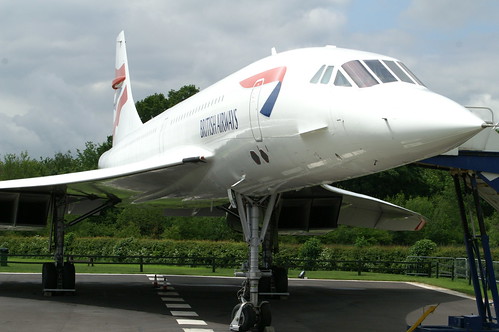
Mach 1 ride on Concorde at Oshkosh 88!


(image courtesy of Dave Hamster. Released under a Creative Commons Attribution license)

It's not often I'll pimp a fairly low quality Youtube video here on the Flying Cafe. But I saw this video on Concorde and figured "What The Hell"

This is a download of a VHS video taken on board a BA Concorde back at the Oshkosh Air Show in 1988.

With the demise of Concorde a few years ago it's impossible for videos like this to be made any more. The high cost of doing something like sending a supersonic plane (one of only 13/14 in existence) to an air show made this prohibitive even before the plane was canceled. Now of course there are no airworthy versions left which means this is a time capsule to the past.

A couple of things to notice. I believe that even on regular flights the cockpit door was left open during the journey and people were allowed to wonder up to the cockpit as they desired (although I'm not sure how this changed after 9/11). According to Dave Gunson the Mach meter isn't actually attached to the instrumentation it's just one of the cabin crew cranking it up behind the scenes (although I'm pretty sure that isn't true). It is true that you can balance a 50p coin on the tray table as the plane transitions through the sound barrier and it will not fall over. It's that smooth.

Just to put the flight in the video in perspective, at the time the Concorde went out of service a transatlantic return ticket LHR to JFK retailed at around $10,000 (£6000). That equates to around £1000 ($1600) per hour for the flight. For this you got a narrow, cramped, leather seat, tiny windows and very little in terms of in-flight movies etc. But you did also get first class cuisine, free champagne, a view of the curvature of the earth from 60,000 ft, priority landing at LHR on the runway closest to the terminal (regardless of the runway in use) and the luxury of knowing that you have bought the one thing that money cannot buy - time: A 10am departure from LHR would get you into JFK at 9.30am, giving you time to hold an important meeting and catch the return flight to arrive back in London on the day you left.

I lived in London for many years and saw, literally, thousands of flights head over the city towards Heathrow. Almost without exception the only plane that made me and other Londoners stop and look twice a day was the Concorde. A fabulous plane.

Has anyone else reading this flown Concorde? Loved it? Loathed it?

Thanks to airpigz for the video which has recently been updated.

10 November, 2008

The UKGA has decided

The guys from the UKGA have now made a decision about how they want to proceed with funding and managing the site...
Dear fellow UKGA-er,

The lines are closed, the votes have been counted, and we can now reveal...

In our first email to you, we said that we wanted to find out just how many people would support us if we made UKGA a commercial site. Well, we've been absolutely overwhelmed by the many kind comments you've sent us, and by the pledges of financial support you've made. It's gratifying to know that even what we've done so far is proving useful to you.

On the basis of your commitments, we've decided to go for it. In the past, when it had to fit around other projects, UKGA moved forward slowly, and we're as excited as you are by the possibilities when we're working on the site every day.

Our top priority is to get UKGA on to a more stable and fast hosting platform, which we're already doing. Because of your support, we're testing our new server now, and we hope to move the site onto it during the next week. We'll be in touch over the next couple of days with details of the move. After that we will be making some immediate changes to the site, particularly to the NOTAM system. We'll be setting up a blog too, so that you'll be able to see what we're working on, what's coming up, and give us your feedback.

One area of concern that has been raised several times is that of what we're going to do with the forum, and whether it should be covered by a membership. We've decided that the forum should be accessible to everyone free on an ongoing basis. Likewise, the classified service has become very popular, and we don't want to stop that valuable service. Therefore, we'll also offer free classified adverts and hopefully extend this with an emailed classified newsletter. The other parts of the site will be available on a subscription basis.

So, the time has come for us to ask you to make good your pledges. As many of you know, we already have PayPal available on the site, which will let you pay by credit card or PayPal account. This is the fastest route, especially via the Paypal link on the site, as it will update UKGA automatically. If you prefer to go to paypal.com directly to send your subscription, please use the same email address that you use for UKGA, otherwise we won't know who has sent us the funds!

If you like, you can send us a cheque: UKGA, 297 College Road, Whitchurch, Cardiff CF14 2NW. You can also pay by bank transfer if you wish. Drop us an email and we'll send you our bank account details.

Finally, we'd like to say an especially warm thank you to everyone who has already sent a contribution. Several people on receiving our email immediately turned to PayPal and sent us a membership fee, without any questions. Thanks again to you all, and thank you to everyone who has supported us in the past.

For now, happy flying, and I can tell you that we're looking forward to delivering more great functionality at UKGA.

Nev & Phil
So there you go!

Well done, guys, looking forward to details of the subscription costs etc....

14 October, 2008

The Future of UKGA......

As many of you will know I have been espousing the virtues of the UKGA web site for a while now.

It is an independent web site set up by a couple of guys who run it pretty much off their own backs.

However things have now come to a head and a decisive movement is needed.

I'll let the guys themselves tell you:

As many of you will know, devoting time to UKGA has been increasingly
difficult for Phil and me during the past few years, as we’ve juggled
the demands of family, challenging clients, and of course UKGA
development and maintenance. 

Indeed, it has been a source of
some frustration to us both that we’ve not been able to devote as much
time as we would wish to development and maintenance.  The pending
queue of content has quite a backlog, and our UKGA programming progress
is frustratingly slow.  Similarly, we’ve also found the financial
pressure of UKGA increasingly difficult to bear.  Although we’ve been
able to support UKGA for several years, it bothers us that we haven’t
been able to invest in new technology as we would have wished – hosting
platforms, bandwidth, new software and services, mapping, text
messaging, and so on, have all taken second place to our immediate
family expenses.

Unfortunately both time and money have become
even more precious recently, as I was made redundant two weeks ago. 
This was an unexpected blow, and it has certainly made both of us very
conscious of where our priorities – in time and money – have to lie.

But
we also see this as a fantastic, and perhaps one-time, opportunity for
UKGA and for us – to provide the world-leading service that we’ve
always dreamt of providing: near-instant comprehensive flight planning;
and to make UKGA the best resource possible for UK general aviation
pilots.

The only way that we can make this happen is for us to
devote ourselves to UKGA and its future, by making UKGA a commercial
enterprise.  If everyone who used UKGA this year (more than 4000 of
you!) paid a membership of, say, £25, we would stand a good chance of
being able to execute our plans fully. 

In practice, of
course, 4000 won’t subscribe, but we’d like to make this decision on
the basis of facts.  We want you to send a pledge to us to show
support.  If enough of you think we’re worth backing, we’ll throw
ourselves into it lock, stock, and two smoking programmers. 

Our
development plan includes drag-and-drop route planning, better NOTAM
mapping, terrain awareness & MSAs, more airfield mapping, W&B
calculation, take-off and landing performance, group management and
booking, and much more besides. 

Send us an email to pledge@ukga.com
to show your support.  We think it’s worth it.  Do you?  Let us know. 
If you want to talk to us about this decision, our operators (me and
Phil) are standing by: 07976 200186 or 07967 323316.  We’ll be happy to
hear what you think. 

Thanks to everyone who has helped us in the past, and we sincerely hope that we can make UKGA fly.

Nev & Phil

So there you go: cough up or potentially lose this excellent resource! £25 a year is very little: It will barely buy you enough aviation fuel to run your Cessna for 30 minutes, but it will mean keeping this excellent little site working for a good while longer.

Send an email to pledge@ukga.com. Show your support!

08 October, 2008

Qantas 747 depressurisation update

You may remember back in July that a Qantas 747 en-route from Hong Kong to Melbourne experienced a sudden depressurisation that ripped a hole in the fuselage just forward of the wing. You may also remember I decried the use of sensationalistic journalism in my post about this incident.

The Air Transport Safety Board preliminary report has been produced for this incident

Apparently one of the row of oxygen containers in the hold spontaneously exploded. The explosion had 2 effects:

1) It blew the hole in the fuselage causing a sudden depressurisation
2) It forced the oxygen container up through the floor of the cabin where it damaged an exit door and an overhead bin before falling back through the hole in the cabin floor and being sucked out of the aircraft through the hole in the fuselage.

So far there is no explanation of why the oxygen tank exploded.

As per the report there was no 'plummeting', just a normal controlled descent to a more suitable altitude. Nobody was hurt in the incident and procedure was followed correctly. In fact, according to industry experts "It may seem like the aircraft is going through a radical maneuver, and
it is radical compared to normal flying, but this is standard protocol."

Nothing to worry about. Move along, please......

10 September, 2008

Come fly the friendly... rails?

In one of those bizarre "Did I really read that?' moments it appears that Air France/KLM are going into the rail travel business.

The EU's rail traffic laws will be liberalised in 2010 allowing non state-owned firms to ply the tracks with their own services. Air France and Veolia are going into partnership to provide international high-speed rail services. Initially they will route between Paris and Amsterdam and Amsterdam and London.

The logic behind this is actually quite sound. Having spent many years as an international commuter (living in London and working in Frankfurt or living in Belgium and working in London), I know that the actual travel time from leaving home to arriving at a destination on such a heavily trafficked route is comparative on rail and air. Competitive rates on the trains coupled with rising fares on the airlines have caused business travellers to start looking at the train as a viable alternative to flying.

The service will potentially run using trains known as the AGV, which can carry up to 900 passengers at a speed of 360 km/h (224 mph). At such speeds, passengers would be able to commute between Paris's Charles de Gaulle airport and Schiphol airport outside Amsterdam in approximately 1.5 hours. That's not bad going at all. A car journey of the same distance would take over 3 times as long and a flight (although only scheduled for about 50 minutes), would probably take somewhere between 2 hours and 3 hours including delays and extended check-in times.

Look for this to occur in October 2010.

28 August, 2008

The air traffic controller who gives after dinner speeches

(Surprisingly enough this post is the most visited individual post on this blog. I thought I would bring it back to the front again so that new visitors would be able to take advantage of it)

I've talked about this before but it's worth saying again: If you know an aviation enthusiast and you're looking for something to give them for a present, you can't beat Dave Gunson's "What goes up might come down"

Dave is an ex- East Midlands Air Traffic Controller who went into after dinner speeches when someone realised that you could talk about pilots and air traffic control in a very amusing way if you put the correct spin on it.

His most famous talk was to a bunch of merchant bankers in Birmingham (I think) which was recorded and released as a CD.

My favourite part, personally, is the discussion of flying on Concorde with the details of how heat causes it to expand and contract. Plus the Machmeter ("It's not really attached to anything. there's a stewardess at the front cranking it up manually").

This can be purchased from a number of places but Amazon is probably the easiest. Click here for a link

Enjoy!

25 July, 2008

Qantas plane plummets from the sky!

Talk about sensational journalism. I've just read a headline similar to the title of this blog post which talks about a plane "plunging 20,000 feet in terror" after a 10ft hole appeared in the side.

Now I'm not discounting any of the reports that have appeared in the press. I also know and understand that a hole that size in the side of a pressurised plane at altitude is not normal and needs to be dealt with. But I do believe that sensationalist reporting like that needs to be controlled.

Here's what we know as facts.

A Qantas 747 from London to Melbourne had taken off from Hong Kong an hour earlier and a hole appeared in the side of the plane. We don't know why. It caused a depressurisation which would have resulted in 2 things:

1) The oxygen masks would have appeared
2) The pilots would have executed an emergency descent to an altitude where the air was more breathable.

The aircraft touched down safely at Manila at 11.15am local time and all 346 passengers and 19 crew disembarked normally.
Anything other than that is pure speculation. A 20,000ft terror plunge is pure speculation and hyperbole

From the sounds of things there were no injuries, no damage to anyone and only a few passengers suffering from vomiting.

I'll keep an eye on this story for you. I'm interested to know what caused the damage ahead of the starboard wing which apparently penetrated the cabin.

The BBC appears to have the most well balanced view of the story at the moment

21 July, 2008

Farnborough


Well yesterday was the last day of the Farnborough International Air show 2008 and I blagged a ticket courtesy of a major aerospace manufacturer. No names but it was a bit of a stealth attack if you get my meaning. . .

Despite the fact that I live 10 minutes from the place and have done for 11 years, this was my first time at the show. The queues were quite long and I ended up parking in a different post code but I finally got there.

The interesting thing is that the airshow is actually more show than air on public days. It has something of a carnival atmosphere with children's play areas, fast food stalls, racing car displays, simulator rides and an inflatable castle/slide. It's only when you get deeper into things that you see the static displays and the exhibitor pavilions. Unfortunately most of those pavilions were invite only. And I didn't have an invite!

Air displays:
Running in parallel with all this were the air displays which were quite spectacular. I saw the Hornet, the Blades display team (awesome aerobatics from a bunch of ex Red Arrows pilots), the Navy Lynx display choppers - who flew backwards along the runway, in formation, against a strong crosswind- the Battle Of Britain flight - a Spitfire, Hurricane and Lancaster bomber making low passes over the airfield- the Hawker Sea Hawk, and the first flight of a completely restored Vulcan bomber.

To be honest the Vulcan was more impressive than I thought as it was very loud, very big and climbed out at what looked to be a very steep angle. A lot of people spent a lot of money putting it back together and they still need more money to keep it flying.

Static displays:
In a way I was a little disapointed with the static displays Don't get me wrong there were quite a few of them, but with one or two exceptions they were all 'Stand at a dstance and watch' displays rather han 'Get up close and personal' displays. The exceptions were the US Air Force Galaxy, Hercules and F15 displays - although they were only letting in small groups at a tie and the queue was almost as long as the one to find a parking space to get in! I got onto the Sirrus stand and looked at their new SR22 Turbo as well as the SR20. Also, despite what you may have read on the Farnborough website, the Boeing 777 and several of the other static displays were not there - at least not on the Sunday. However one welcome arrival was the Airbus A380 which was parked on the end of the cross runway (the only place it would fit). This too was open for inspection - although only for invited people, which was a shame. i watched it for about 30 minutes and saw 8 people wonder inside it. The theme of the A380 was 'Environmentally recyclable' and I had to smile at the irony of pushing an environmental agenda when there were fuel guzzling fighter jets and the old Vulcan bomber flying overhead....

By the way, Blades display team are actually a fully licensed airline which means that you can fly with them, as a fully insured paying passenger, in the front seat of one of their Extra's. How cool is that!

Technorati Tags: , ,

15 July, 2008

Why the airlines should hire behavioural economists

Scott Shane, A. Malachi Mixon III, Professor of Entrepreneurial Studies at Case Western Reserve University, has put forward a radical idea to help the airlines beat falling passenger numbers and higher costs.

He is recommending that airlines hire behavioural economists to understand how different framing of a problem can solve bigger issues. For example: How about the airlines paying passengers for NOT checking bag's in.

The principle works like this:

In a 'normal' situation, an average human considers benefits and losses on different scales. Thus finding $50 is proportionately more enjoyable than the pain of losing that $50, even though it's the same $50.

Knowing this he is recommending airlines change their pricing structures to take advantage of it.

At the moment you may buy an airline ticket for $150. Then when you get to the airport you check in 2 bags at $5 each. You ask for an aisle seat which costs another $5. During the flight you buy your $5 sandwich and $3 drink and spend another $5 on the headset to listen to the movie. In total your $150 flight has cost you $178.


So let's change the paradigm and take a behavioural economists approach to this:

You buy your ticket for $178. When you get to the airport you decide to check in only one bag. The airline refunds you $5 for the other bag not checked in. You still opt for the aisle seat but decide against watching the movie (which you've seen before). You get $5 back for not hiring the headset. You still have the food and the drink. At the end of the day your airline ticket cost you ($178 - $5 - $5 = $168). Overall you've spent more than the original $150 that ticket would have cost you, but you've spent less than the $178 you paid for the ticket. And, more importantly, you got $10 back off the airline.


From the airline's point of view the seat earned them the $150 they originally wanted for it, but they also made an additional $18 for the aisle seat, the food & drink and the one checked bag. Because this covers their costs they don't mind paying back the money to the customer and, on top of that, the customer feels better spending $168 for their $150 dollar ticket, than $150 for the ticket with 'surcharges' on top.

Refunds always beat surcharges, regardless of the overall cost at the end of the day.

I think this is a great idea. Richard Branson - are you listening....?

13 June, 2008

Flying on nothing but fumes and... algae?

Boeing have recently announced that they are promoting the use of algae based fuels in their engines. Or to be more precise they are looking at using algae based energy sources as a means of replacing the worlds reliance on fossil fuels for aviation. The logic behind this is quite simple: Raw algae is fast growing and does not need fresh water. It also doesn't conflict with food quotas (a charge often leveled at biofuels made from corn, for example) This in turn won't drive up the price of food in the short term. With some experts predicting oil will rise to $400 per barrel this makes financial sense.

Of course it is one thing to test a particular fuel in a particular engine on a single flight (as Virgin Atlantic did recently), but in order to make Algae biofuel viable there has to be a supporting infrastructure according to a steering committee of the Algal Biomass Organization, a nonprofit that promotes and advocates for the development of commercially viable transportation fuels.

In order to achieve that viability, Algae-based fuels need a supply chain the committee says, adding such fuels are in the early stages of development. The organization aims to accelerate the development of such power sources.

Over the coming months both Air New Zealand and Continental will make test flights using biofuel in one of the engines, and Virgin Atlantic is hoping a trial can be performed using algae as a biofuel source next year.

How quickly before this filters down to the average Lycoming or Continental engine used in GA...?

25 February, 2008

What goes up might come down

Many years ago I was lucky enough to be given a copy of a tape by a guy named Dave Gunson. Dave was an air traffic controller at East Midlands airport and had made a bit of a niche for himself as an after-dinner speaker.

This particular tape was a speech he gave to a room full of bankers and it talks about his role as an air traffic controller.

Sounds boring, right? Wrong! This is one of the funniest recordings I've heard in a long while and is definitely one of the best as far as aviation is concerned.

He'll talk about working with French Air Traffic Control. ("Non!'), how airports make their money ("You can make as many take-offs as you want free of charge. We'll only charge you for the landings"), flying the Concorde ("It stretches nearly a foot every time we go supersonic. Its a good job it shrinks back otherwise we'd have the longest plane you've every seen after a couple of months"), and many other aviation themed topics.

Amazon are selling it here in the UK What Goes Up Might Come Down!

You could also check out the list of books I recommend, including some great ones by Rod Machado the voice of Microsoft's Flight Simulator and a genuine aviation humourist himself.

22 February, 2008

Introducing "Fly-On Track" - Airpsace infringement prevention advice

One of the things that Private pilots have a tendency to do much more than the airline jockeys is to infringe restricted airspace. 99% of the time it is as a result of bad navigation or not paying attention or not realising that there is a restriction in place. It's is very rarely, if ever, deliberate.

Nonetheless there are an increasing number of controlled (or restricted) airspace infringements on a year by year basis. In just about every case where this happens there is an impact on other air users. Whether it is a controller having to divert 747's around you to avoid an airprox, or an air show having to cancel a Red Arrows display, the impact on others is rarely negligible.

Fly-On Track is a web site that aims to inform pilots of the impact of these infringements as well as educate them on methods of avoiding infringement, providing links to sources of controlled airspace information and also highlight the dangers and impact of an infringement.

One of my favourite parts of the site is the radar displays. This shows actual radar scans from NATS of various light aircraft infringing airspace and causing problems. Just to emphasise the impact of this, read the section at the bottom of this stats page which quantifies the cost of diverting a 747 from approach. It's more than you think...

The site also has links to a lot of CAA safety sense leaflets which I find invaluable in helping me understand and learn about some of the safety issues in aviation. I also like the printout which you can slip into your kneepad to give you a visual aid to preventing infringement (it also has a template for radio calls to ATC units to help you sound more professional!).

I recommend you allocate a good chunk of time to read through this web site as it has lots of links to lots of different publications and pages. It's a very useful site that should be on every UK aviators bookmarks.

19 January, 2008

The 14 top links to make you a better pilot

As a pilot there are always sites on the Internet that are very interesting to browse.

These tend to fall into distinct categories

A) Sites related to flying an aircraft or preparing for a flight
B) Sites related to the aircraft itself
C) Other aviation sites

Note: These links are primarily UK based

1) Are you connected to the UK General Aviation Website yet? If not, you should be. It has details of every UK airport, a forum, contact details and - I use this all the time - a flight planning facility which automatically looks up weather and relevant contact details for locations you are flying to, through and from.

2) Need a new chart, headphones, or a GPS? There are lots and lots of aviation suppliers on the web. My personal favourites are Transair and AFE Online

3) The Cessna Aircraft Site For those of us wanting to fly the 150, 172 or even the RG versions!.

4) The Piper Aircraft Site For those of us flying Piper Warriors or Cherokee's etc.

5) The Cirrus Aircraft Site I learned to fly with a guy who had just ordered a brand new Cirrus. Lucky guy....!

6) The Tecnam Aircraft Site you know who you are..

7) The Beech Aircraft Site If you're an MS Flight Simulator fan you'll have flow the Beech Bonanza or the King Air. This is the site

8) Airliners. NET
For loads and loads of pictures of aircraft taken in every conceivable position, location and attitude go to Airliners.Net Check out some of the scary approaches into the old Kai Tak Airport in Hong Kong. If video is more your style, check out their sister site

9) Pilot Magazines Web site
If you don't subscribe to Pilot Magazine you can still connect to their web site and read some of the articles in there.

10) The Civil Aviation Authority - They who must be obeyed. If you're applying for a license you can check out the waiting times here. If you're looking to buy a plane you can check out the registration details here

11) Irv Lee's Web Page.
The layout is a little garish - bordering on ugly, but it has loads and loads of information on it. Irv will give you lots of advice, help you and instruct you - he's also a key Southern England RT License instructor

12) A High Viz Vest with built in plane chock.
This is a brilliant idea and I use it all the time. It's a proper High-Viz vest for going airside and a handy chock you can use on your aircraft wheels when you get to your destination

13) The Private Pilot Simplifier - It's the book that has all the answers for you for pilot exams, but it's also incredibly useful when you're in an unfamiliar situation yourself. Get the question, look at the answer and it explains the answer to you as well. Great for those situations when you aren't sure whether your actual altitude increases or decreases with a drop in air pressure (It decreases... "High to low, down you go"))

14) Microsoft's Flight Simulator : I know pilots tend to "pooh pooh" the MS Flight Simulator but I honestly believe that the reason I managed to learn to fly so quickly is because I have many hours of simulator experience. While the feelings etc, aren't as realistic as a proper plane, the mechanics and the focus and attention needed are just as real. Plus you can fly when the real weather is Baaaaad! (See more Sim products in our store)

That's my list. Got any more you would like to add?


Digg!

Apture