Nordo is an acronym meaning "No Radio". It refers to a plane which has suddenly lost radio contact with air traffic controllers.
In an earlier post I asked the following questions: How many people, for instance, know what to do in the case of a complete radio loss? What Transponder code do you use? How do you approach an airfield to land without the radio? What do the signals mean?
I promised the answers in a future post so here they are: (The assumption here is that you are flying VFR with a transponder. If you are flying IFR the procedure is much different and more complicated. See the AIP for more details)
In case of a complete radio loss it is vital to let ATC know. The quickest way to do that is to dial in the correct transponder frequency. In the UK this is 7600. In most radar controlled ATC units this will automatically add a label to your aircraft signal which wil indicate "Radio Failure".
However it is useful to actually ensure you have had a radio failure. I remember on a recent flight I was returning to Thruxton and couldn't raise them on the radio at all. I tried several times, switching out of the frequency and back in. Then - on re-checking the radio - I realised I had missed their radio frequency by .25 Mhz on the dial. Once had rechecked I called them up again and they answered.
So the first thing to do is check your equipment: Check the frequency. Use a different radio if you have one. Use a different headset. Make sure your radio is actually receiving power (a lot of radios now have a separate power switch). Make sure the volume and squelch are at appropriate levels.
If you've done your trouble shooting and your radio is genuinely not working then squawk 7600 to let folks now. Find the nearest airfield and look for light signals from the ATSU.
Light signals:
The following light signals are standard:
Steady red: Give way to other aircraft in air. Stop if on ground
Red pyrotechnic light or red flare : Do no land, wait for permission
Red flashes: Do not land - aerodrome not available for landing (if flying). move clear of landing area (if on ground)
Green flashes: Return to aerodrome wait for permission to land (if flying). To aircraft: you may move on the manouvering area and apron. To vehicle: you may move on the manouvering area
Steady green: You may land (if flying). You may take off (if on ground)
White flashes: Land at this aerodrome after receiving continuous green light then, after receiving green flashes proceed to apron (if flying). Return to starting point on aerodrome (if on ground)
If you are an aircraft able to give light signal to an ATSU, these are the options
Red pyrotechnic light or red flare : May I land?
Steady green or flashing green or green pyrotechnic or flare: May I land (by night). May I land in a different direction to that indicate by the T? (by day)
White flashes or white pyrotechnic light or switching landing lights on and off or irregular flashing of Nav lights: I am compelled to land
Remember these, they could come in useful
16 August, 2008
11 August, 2008
Looking at Variable Pitch Prop Training
I mentioned in an earlier post that one of the things you can do to improve your general level of safety while flying is to get further training. Yes, it's usually expensive, but it is also your life you're talking about so it's probably worth it!
How many people, for instance, know what to do in the case of a complete radio loss? What Transponder code do you use? How do you approach an airfield to land without the radio? What do the signals mean? Something like this could save your life. (* answers in a later post - stay tuned!)
On the subject of training I'm looking at doing some additional training related to variable pitch propellers. I have managed to ingratiate myself into a group running a Cessna 182 Skylane and the guy running the group is an instructor (and Air Traffic Controller) who will give me the necessary training.
I went up to see the plane over the weekend. It's a 1972 Skylane with Autopilot, Garmin GPS (yoke mounted), redundant radio etc, etc, etc. Also, because it has the Continental VP prop there is the extra lever in the throttle quadrant (not that Cessna's have a throttle quadrant as such, just a line of levers sticking straight out of the panel)
Hopefully I should be able to get a couple of hours training to work out the peculiarities of VP props. In addition to that the training should also allow me work out the best way to land this big, heavy beast (remember I'm used to flying little PA28's around the sky, this is a big step up for me). According to the instructor, landing is achieved by remembering that 'The 182 is actually a two wheeled aircraft for landing - the nose wheel is there merely to stop the prop from striking the ground".
Having spent 15 minutes sat in the cockpit and looking at everything it does remind me how familiar I am with the PA28 layout and how alien some of the controls are in the 182 (There's a whole section of the panel that has the autopilot controls!! The circuit breakers are hidden behind my yoke!! What's this panel with the knurled knob's on it near my feet??) no doubt it will all become clear in time.
More updates as they happen

31 July, 2008
Flying tip 4 - Radio comms
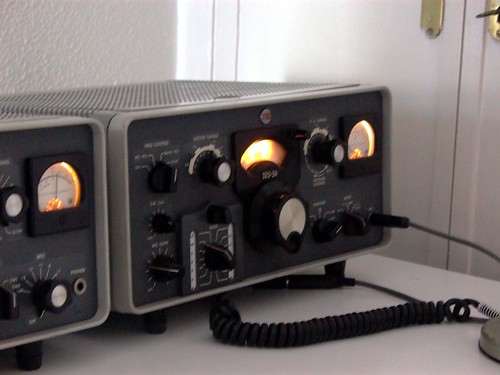
Radio communication is vital in todays aviation world.
An increase in air traffic - coupled with pressures in schedules and increased expectations from airline passengers - has resulted in more planes moving around the sky at any one time.
This has manifested itself in an increased workload on air traffic controllers. This was something that was pointed out to me on my recent trip to Farnborough's Air traffic control facilities.
What was pointed out again and again is the need for pilots to be in contact with controllers and for them to have good communications skills.
Here's a challenge for you. Take a small airband scanner to your local airport and tune in to the tower frequency. Listen to what is being said and then see how many exchanges completely follow the standard comms pattern defined by the CAA. For example, the use of pleasantries is discouraged and all altitude readings need to have an altimeter pressure setting read back with them. (i.e. "... level at 3500ft, 1012").
Now change frequency and listen to the local LARS or zone controller. When a new aircraft comes on frequency and is told to "pass your message", listen how many do it right.
The correct sequence is:
- Call-sign
- Aircraft type,
- Point of departure and destination,
- Altitude with altimeter setting,
- Intentions
- Request
Todays quick tip then is "Learn the expected items to pass on a radio contact (along with what needs to be read back to the controller)"
It makes things easier for everyone AND ensures everyone has all the information needed for a safer journey
photo courtesy of Nite_Owl
25 July, 2008
Qantas plane plummets from the sky!
Talk about sensational journalism. I've just read a headline similar to the title of this blog post which talks about a plane "plunging 20,000 feet in terror" after a 10ft hole appeared in the side.
Now I'm not discounting any of the reports that have appeared in the press. I also know and understand that a hole that size in the side of a pressurised plane at altitude is not normal and needs to be dealt with. But I do believe that sensationalist reporting like that needs to be controlled.
Here's what we know as facts.
From the sounds of things there were no injuries, no damage to anyone and only a few passengers suffering from vomiting.
I'll keep an eye on this story for you. I'm interested to know what caused the damage ahead of the starboard wing which apparently penetrated the cabin.
The BBC appears to have the most well balanced view of the story at the moment
Now I'm not discounting any of the reports that have appeared in the press. I also know and understand that a hole that size in the side of a pressurised plane at altitude is not normal and needs to be dealt with. But I do believe that sensationalist reporting like that needs to be controlled.
Here's what we know as facts.
A Qantas 747 from London to Melbourne had taken off from Hong Kong an hour earlier and a hole appeared in the side of the plane. We don't know why. It caused a depressurisation which would have resulted in 2 things:Anything other than that is pure speculation. A 20,000ft terror plunge is pure speculation and hyperbole
1) The oxygen masks would have appeared
2) The pilots would have executed an emergency descent to an altitude where the air was more breathable.
The aircraft touched down safely at Manila at 11.15am local time and all 346 passengers and 19 crew disembarked normally.
From the sounds of things there were no injuries, no damage to anyone and only a few passengers suffering from vomiting.
I'll keep an eye on this story for you. I'm interested to know what caused the damage ahead of the starboard wing which apparently penetrated the cabin.
The BBC appears to have the most well balanced view of the story at the moment
21 July, 2008
Farnborough

Well yesterday was the last day of the Farnborough International Air show 2008 and I blagged a ticket courtesy of a major aerospace manufacturer. No names but it was a bit of a stealth attack if you get my meaning. . .
Despite the fact that I live 10 minutes from the place and have done for 11 years, this was my first time at the show. The queues were quite long and I ended up parking in a different post code but I finally got there.
The interesting thing is that the airshow is actually more show than air on public days. It has something of a carnival atmosphere with children's play areas, fast food stalls, racing car displays, simulator rides and an inflatable castle/slide. It's only when you get deeper into things that you see the static displays and the exhibitor pavilions. Unfortunately most of those pavilions were invite only. And I didn't have an invite!
Air displays:
Running in parallel with all this were the air displays which were quite spectacular. I saw the Hornet, the Blades display team (awesome aerobatics from a bunch of ex Red Arrows pilots), the Navy Lynx display choppers - who flew backwards along the runway, in formation, against a strong crosswind- the Battle Of Britain flight - a Spitfire, Hurricane and Lancaster bomber making low passes over the airfield- the Hawker Sea Hawk, and the first flight of a completely restored Vulcan bomber.
To be honest the Vulcan was more impressive than I thought as it was very loud, very big and climbed out at what looked to be a very steep angle. A lot of people spent a lot of money putting it back together and they still need more money to keep it flying.
Static displays:
In a way I was a little disapointed with the static displays Don't get me wrong there were quite a few of them, but with one or two exceptions they were all 'Stand at a dstance and watch' displays rather han 'Get up close and personal' displays. The exceptions were the US Air Force Galaxy, Hercules and F15 displays - although they were only letting in small groups at a tie and the queue was almost as long as the one to find a parking space to get in! I got onto the Sirrus stand and looked at their new SR22 Turbo as well as the SR20. Also, despite what you may have read on the Farnborough website, the Boeing 777 and several of the other static displays were not there - at least not on the Sunday. However one welcome arrival was the Airbus A380 which was parked on the end of the cross runway (the only place it would fit). This too was open for inspection - although only for invited people, which was a shame. i watched it for about 30 minutes and saw 8 people wonder inside it. The theme of the A380 was 'Environmentally recyclable' and I had to smile at the irony of pushing an environmental agenda when there were fuel guzzling fighter jets and the old Vulcan bomber flying overhead....
By the way, Blades display team are actually a fully licensed airline which means that you can fly with them, as a fully insured paying passenger, in the front seat of one of their Extra's. How cool is that!
Technorati Tags: farnborough, airshow, air show
15 July, 2008
Why the airlines should hire behavioural economists
Scott Shane, A. Malachi Mixon III, Professor of Entrepreneurial Studies at Case Western Reserve University, has put forward a radical idea to help the airlines beat falling passenger numbers and higher costs.
He is recommending that airlines hire behavioural economists to understand how different framing of a problem can solve bigger issues. For example: How about the airlines paying passengers for NOT checking bag's in.
The principle works like this:
In a 'normal' situation, an average human considers benefits and losses on different scales. Thus finding $50 is proportionately more enjoyable than the pain of losing that $50, even though it's the same $50.
Knowing this he is recommending airlines change their pricing structures to take advantage of it.
So let's change the paradigm and take a behavioural economists approach to this:
From the airline's point of view the seat earned them the $150 they originally wanted for it, but they also made an additional $18 for the aisle seat, the food & drink and the one checked bag. Because this covers their costs they don't mind paying back the money to the customer and, on top of that, the customer feels better spending $168 for their $150 dollar ticket, than $150 for the ticket with 'surcharges' on top.
Refunds always beat surcharges, regardless of the overall cost at the end of the day.
I think this is a great idea. Richard Branson - are you listening....?
He is recommending that airlines hire behavioural economists to understand how different framing of a problem can solve bigger issues. For example: How about the airlines paying passengers for NOT checking bag's in.
The principle works like this:
In a 'normal' situation, an average human considers benefits and losses on different scales. Thus finding $50 is proportionately more enjoyable than the pain of losing that $50, even though it's the same $50.
Knowing this he is recommending airlines change their pricing structures to take advantage of it.
At the moment you may buy an airline ticket for $150. Then when you get to the airport you check in 2 bags at $5 each. You ask for an aisle seat which costs another $5. During the flight you buy your $5 sandwich and $3 drink and spend another $5 on the headset to listen to the movie. In total your $150 flight has cost you $178.
So let's change the paradigm and take a behavioural economists approach to this:
You buy your ticket for $178. When you get to the airport you decide to check in only one bag. The airline refunds you $5 for the other bag not checked in. You still opt for the aisle seat but decide against watching the movie (which you've seen before). You get $5 back for not hiring the headset. You still have the food and the drink. At the end of the day your airline ticket cost you ($178 - $5 - $5 = $168). Overall you've spent more than the original $150 that ticket would have cost you, but you've spent less than the $178 you paid for the ticket. And, more importantly, you got $10 back off the airline.
From the airline's point of view the seat earned them the $150 they originally wanted for it, but they also made an additional $18 for the aisle seat, the food & drink and the one checked bag. Because this covers their costs they don't mind paying back the money to the customer and, on top of that, the customer feels better spending $168 for their $150 dollar ticket, than $150 for the ticket with 'surcharges' on top.
Refunds always beat surcharges, regardless of the overall cost at the end of the day.
I think this is a great idea. Richard Branson - are you listening....?
12 July, 2008
Braille Controllers.....
So I read in the papers that St. Mary's airport on the Scilly Isles has been advertising for a new air traffic controller. Nothing unusual about that you may think. However following equal opportunity guidelines response to the advert can be received in Braille.
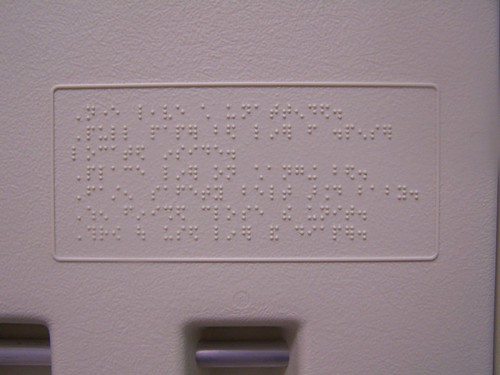 Now I can think of numerous jobs where blind and partially sighted people would have no problem undertaking (we already have blind politicians and sportsmen/ women), but if I'm flying the crowded skies of Southern England (or even the sparse skies over the Scilly Isles), I would like to think that the person operating the radar could at least see it!
A spokesman for the Council of the Isles of Scilly, which runs the airport, said the alternative formats were offered on all job adverts.
(Phot courtesy of pne)
Now I can think of numerous jobs where blind and partially sighted people would have no problem undertaking (we already have blind politicians and sportsmen/ women), but if I'm flying the crowded skies of Southern England (or even the sparse skies over the Scilly Isles), I would like to think that the person operating the radar could at least see it!A spokesman for the Council of the Isles of Scilly, which runs the airport, said the alternative formats were offered on all job adverts.
(Phot courtesy of pne)
Subscribe to:
Posts (Atom)
